Privacy Policy
Thor is an app manager for Android. This policy covers what the app does with the information on your device — and what this website does with the fact that you visited it.
Thor is written and maintained by one independent developer, Trinadh Thatakula. There is no company and no team behind it, so where this policy says “I”, that is who it means. Thor and the App mean the same thing throughout: the Thor Android application.
The short version: Thor collects nothing about you. There is no analytics, no crash reporting service, no advertising library and no telemetry of any kind. Thor’s own code makes exactly one kind of network request, only when you ask for it. The Google Play build additionally bundles Google Play Billing, which opens a connection to Play when the app opens. Both are described in full below.
Free and open source
Thor is released under the GNU General Public Licence v3.0 or later, so every claim on this page can be checked against the source rather than taken on trust: github.com/trinadhthatakula/Thor.
If you find anything in the code that contradicts this document, that is a bug and I want to hear about it.
What Thor collects
Nothing.
Thor contains no analytics SDK, no crash reporting service, no advertising library, no attribution framework and no telemetry. I do not know how many people use Thor, which features they use, what is installed on their devices, or that any particular device exists.
Thor sends nothing to me. The one request its own code makes goes to GitHub, and all it asks for is a public file. The Google Play build’s billing client talks to Google Play, and nothing in it reaches me either.
When Thor uses the network
Thor declares the INTERNET permission in app/src/main/AndroidManifest.xml, so both builds have
it. In Thor’s own code it is there for one feature: the optional Extension Store, which fetches
a catalog of add-on packages and downloads the one you choose.
Exactly one source file in Thor’s own code opens a connection itself, and you can confirm that yourself in a checkout:
Every network call site in Thor's own source
$ grep -rl openConnection app/src
app/src/main/java/com/valhalla/thor/data/repository/StoreRepositoryImpl.kt
That grep covers Thor’s code and says nothing about its libraries, which is why the Google Play build gets a section of its own below. The FOSS build has nothing beyond what the grep shows.
When it happens
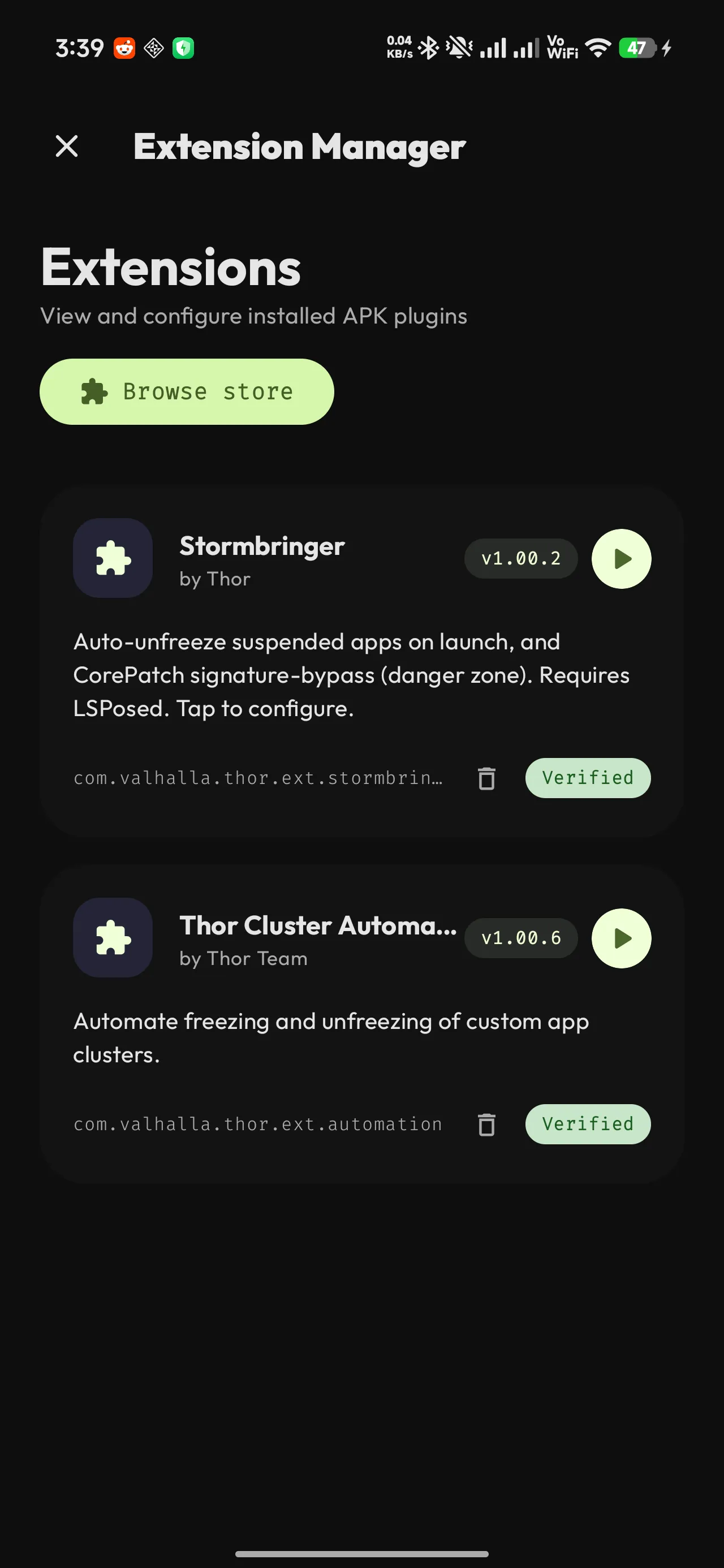
Only when you open the Extension Manager. If you never open it, the Extension Store makes no request — not at startup, not while it scans your apps, and not while it freezes or installs anything. In the FOSS build that is the whole of Thor’s network behaviour.
What is sent
An ordinary HTTPS GET. Thor sends no identifiers, no device information, no account details and
nothing about the apps installed on your device. There is nothing in the request that describes you.
Who receives it
GitHub. The catalog is a public file at raw.githubusercontent.com, and an extension package is
downloaded from github.com or its githubusercontent.com asset CDN. Thor refuses any other host,
refuses any URL that is not HTTPS, and re-checks the host at every redirect hop rather than only on
the first request.
As with any request to any website, GitHub’s servers can see your IP address and the request itself. That is inherent to how the internet works rather than something Thor adds, and it is governed by GitHub’s own privacy policy. It never reaches me.
What is downloaded, and what is checked
Before an extension package can reach the installer it has to pass all of these, in order:
- It must have a download URL.
- That URL must be HTTPS.
- The host must be GitHub — re-checked at every redirect, so neither the catalog nor a rogue redirect can steer the download somewhere else.
- It is downloaded and SHA-256 hashed in a single streaming pass.
- Where the catalog pins a hash, the hash must match it.
- The package’s signing certificate must match a key pinned inside Thor. This check is unconditional and has no bypass.
- Only then is it handed to the installer.
Anything that fails is thrown away rather than installed. Signatures are checked again each time an extension is loaded, not only when it was installed; one that fails is shown as Untrusted (Blocked) and never loaded.
An extension is a separate application with its own behaviour and its own responsibilities, and it is not covered by this policy. The Extensions policy covers what you are agreeing to when you use one.
The Google Play build, and Play Billing
The store flavour — the build on Google Play — bundles Google Play Billing
("storeImplementation"(libs.play.billing) in app/build.gradle.kts) and declares a tenth
permission, com.android.vending.BILLING, in app/src/store/AndroidManifest.xml. It is there for
one feature: the optional support-the-developer subscription in Settings.
The part worth stating plainly is when it runs. BillingProcessorImpl is a singleton whose
constructor calls connectToBilling(), and MainScreen — the root screen — injects it. So the
connection to Google Play opens when you open the app, not when you go looking for the Support
screen. Once Play answers, Thor asks it for the four subscription products and for any subscription
you already hold. Neither call carries an identifier Thor invented, and no result of either is sent
to me. The file is
app/src/store/java/com/valhalla/thor/presentation/settings/BillingProcessorImpl.kt.
The FOSS build — GitHub Releases and IzzyOnDroid — has none of this. Its copy of that same file is
a stub: the billing library is not on its classpath, every method is empty, and isBillingAvailable
is a constant false. There is no app/src/foss/AndroidManifest.xml at all, so the BILLING
permission is not in that build either. Its Support screen is three links — GitHub Sponsors, Patreon
and PayPal — and each one opens your browser only if you tap it.
What Thor stores on your device
Thor keeps a few things locally, and only locally:
| What | Why |
|---|---|
| A cache of your installed apps’ metadata | So the app list appears at once instead of rescanning at every launch |
One cached icon per installed app, under files/app_icons/ |
So icons load without repeated decoding |
| Your Freezer watchlist and your freeze profiles | So Thor knows what you have switched off, and what a profile contains |
| Your settings — theme, language, layout, privilege mode and so on | So Thor stays how you left it |
The metadata cache, the watchlist and the profiles live in a Room database called thor_database;
the icons are PNG files under files/app_icons/; the settings live in a DataStore file called
thor_preferences. Uninstalling Thor takes all of it with it.
One exception to “only locally” is Android’s own backup, which is described below.
What Thor does to other apps
Freezing switches an app off in place. The package stays installed and keeps its data — Thor is disabling it, not removing it, and unfreezing brings it back the way you left it. That is true for your own apps and for preinstalled system apps alike.
A small number of devices, mostly some OEM builds, refuse to let a preinstalled app be switched off at all by anything but root. On those, Shizuku and Dhizuku cannot freeze that app, and Thor reports the refusal and leaves the app installed and running. It does not substitute a removal — earlier builds did, taking the package away for your Android user with the data kept, and that was withdrawn precisely because it is not what a freeze was asked to do. Nothing here removes an app unless you asked for an app to be removed.
Everything else Thor can do to an app — force stop, clear cache, clear the app’s storage, uninstall, reinstall — happens only when you choose it. Thor never runs a package-management command you did not ask for. The one thing that runs without a fresh tap is auto-freeze, which is off by default: switch it on and Thor freezes the apps already on your watchlist each time the screen goes off.
Android’s backup, and the one file it copies
Thor allows Android’s Auto Backup. That is a platform feature rather than something Thor implements: if you have backup turned on in your device’s settings, Android may copy some of an app’s data to your Google account, and to a new phone during a device-to-device transfer.
Thor’s backup rules are an allowlist with exactly one entry — the settings file, thor_preferences.
Theme, sort and filter, layout, privilege mode, freezer mode, biometric lock and friends. Flags and
enum names, and nothing else.
Deliberately left out, so they never leave your device this way:
- The Room database, which is where the app metadata cache, the Freezer watchlist and the freeze profiles live.
- The cached app icons, one image per installed app.
- Everything in the cache directory, which is installer scratch space.
- The second DataStore file,
thor_local_state, which records facts about the database above rather than anything you chose.
The rules are in app/src/main/res/xml/backup_rules.xml and
app/src/main/res/xml/data_extraction_rules.xml — two files, because Android changed the format
partway through the range of releases Thor supports, and they say the same thing. What Google’s
backup service does with what it holds is governed by your device’s backup settings, which you can
turn off in Android’s own settings.
Permissions Thor requests, and why
| Permission | Why |
|---|---|
QUERY_ALL_PACKAGES |
To list the apps installed on your device. This is the core function of an app manager and Thor cannot work without it. The list never leaves your device. |
INTERNET |
Declared for the Extension Store described above, in both builds. The manifest comment directly above the line says so. |
REQUEST_INSTALL_PACKAGES |
To hand an APK to Android’s package installer when you install one. |
REQUEST_DELETE_PACKAGES |
To uninstall an app when you ask. |
RECEIVE_BOOT_COMPLETED |
So Thor starts after a restart and re-arms auto-freeze if you have it switched on. BootReceiver itself only writes a log line; ThorApplication does the arming. |
POST_NOTIFICATIONS |
To report the result of a batch operation from the quick-settings tile or a launcher shortcut, neither of which has a screen to report it on. |
PACKAGE_USAGE_STATS |
To read per-app storage and cache sizes, which Android only reports to an app holding Usage Access. You can grant it in Android’s settings; where you have already granted root or Shizuku, Thor grants itself the app-op instead, with the one appops command in UsageAccessManager.kt. The figures are shown to you and go nowhere else. Thor reads no usage history. |
WRITE_EXTERNAL_STORAGE |
Legacy file writing on the oldest release Thor supports. |
| Shizuku and Dhizuku API permissions | To talk to those services, when you have chosen one as your privilege mode. |
com.android.vending.BILLING — Google Play build only |
For the optional support-the-developer subscription. It is declared in app/src/store/AndroidManifest.xml, which is merged into the Google Play build and not into the FOSS one. |
WRITE_EXTERNAL_STORAGE carries a maxSdkVersion equal to Thor’s minSdk, so it is requested on
Android 9 and on nothing newer.
Root access, where you grant it, is used to run the package-management commands that correspond to
actions you took in the app, and the one appops command that grants Thor its own Usage Access. It
is not used for anything else.
Third parties
The FOSS build has no third-party SDK that processes your data.
The Google Play build has one: Google Play Billing, described above. It is Google’s code rather than mine, it talks to Google Play, and it is there for the optional subscription. Nothing in it reports to me.
Neither build contains an analytics SDK, a crash reporting service, an advertising library or an
attribution framework. You can check that against gradle/libs.versions.toml and the dependencies
block of app/build.gradle.kts, which is the whole list.
Thor’s distribution channels are a separate matter from Thor. If you install Thor from Google Play, Google’s own data practices apply to that transaction — that is Google Play’s behaviour rather than Thor’s, and it applies equally to every app you install from there. Downloading Thor from GitHub Releases or from IzzyOnDroid avoids it entirely.
About this website
Everything above is about the Thor app. The page you are reading is a different thing, and it would be dishonest to describe the app’s network behaviour this carefully and then say nothing about the site making the claim.
thor.trinadhthatakula.com is a static site. There is no backend, no database, no accounts and no
forms. It sets no cookies and runs no analytics — not Google’s, not the host’s own, not a
self-hosted one. Nothing here tries to work out who you are or whether you have been here before.
The configuration that builds it has no server adapter and no analytics integration, and it sits in
the Thor repository next to the app it describes.
It is hosted by Vercel, which has a consequence worth stating plainly rather than leaving you to discover it:
- Why your IP address is involved at all. It is the address the page is sent back to. Answering an HTTP request requires it, so this is not a choice anyone made.
- Who sees it. Vercel, as the host, in its own server logs. I never receive it: there is no log drain configured, no analytics enabled, and no server-side code on this site, so nothing forwards a request anywhere.
- How long it is kept. By Vercel, under Vercel’s retention, not under anything I set. Their handling is described in Vercel’s privacy notice. I would rather link the authoritative document than paraphrase a retention period that can change without this page noticing — which is how the last policy went stale.
- What Cloudflare does and does not see. Cloudflare answers the DNS query for this domain and nothing else. The record is set to DNS-only, so Cloudflare is not proxying the site: it never sees your request for this page, only the lookup that turns the name into an address — and that lookup normally reaches it from your resolver rather than from you.
None of this changes the app’s position. Thor still sends nothing to me, and installing Thor does not require visiting this site.
Children
Thor is a system utility for advanced users. It is not directed at children, and it collects no data from anyone, children included.
Changes to this policy
If Thor’s behaviour changes in a way that affects this policy, this document is what gets updated, and the date at the bottom changes with it. Because Thor is open source, you can also watch any such change land in the commit history.
I would rather correct this document than let it drift — which is exactly why this version exists.
Contact
Thor is written and maintained by Trinadh Thatakula. If you have a question, a concern or a request about this policy, or about what Thor does with anything on your device, any of these reaches me directly:
- Email: trinadh.thatakula@gmail.com
- Source and issue tracker: github.com/trinadhthatakula/Thor
- Telegram: t.me/thorAppDev
Last updated: 1 August 2026.